
Most Canes Help You Walk. Almost None Help You Get Up.
Why standing up has become the hardest part of the day — and the simple change that lets you do it on your own again
By the Balance & Confidence team

If you've ever chosen a chair because you knew you could get out of it, this is for you.
Or if you've watched your mom or dad do it.
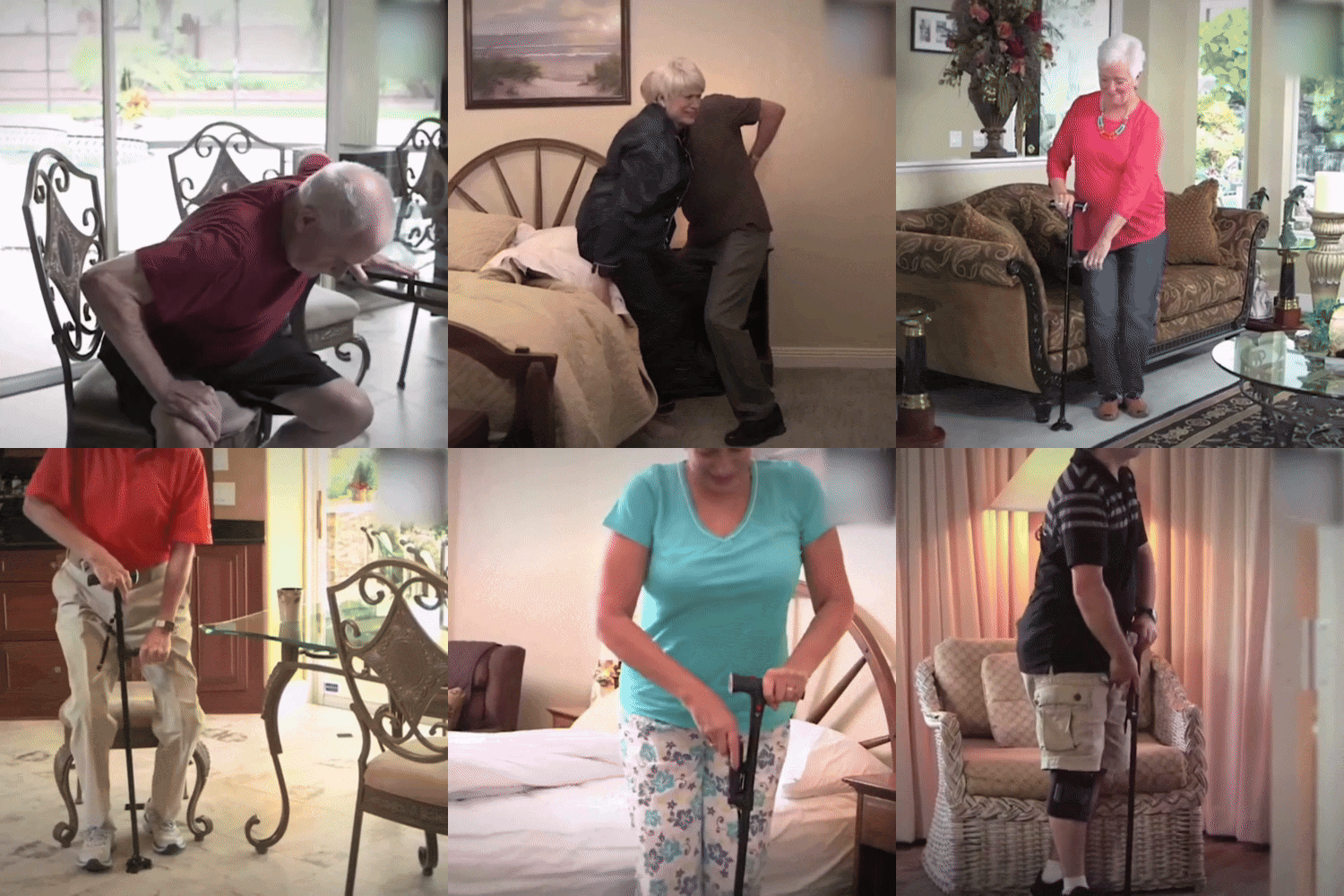
You know the routine. Scoot to the edge. Rock forward. Once. Twice. Look for something to hold: the armrest, the table, the kitchen counter. And too often, someone's arm.
It's not the walking. Plenty of people who struggle to get up walk just fine once they're on their feet.
It's the getting up.
And here's what nobody tells you: your cane was never designed to help with that.
Why your cane can't help you stand up
A cane is fitted for when you're standing. The handle should sit at your wrist when your arm hangs at your side. That's the right height for walking.
But sit down, and that same handle ends up near your chest.
Try pushing yourself up from something at chest height. You can't. There's nothing to push down on.
That's why armrests work: they're low, right beside your hips, where your hands can press down. And it's why people who have trouble getting up end up grabbing whatever is low and nearby. The edge of the table, which slides. A wobbly side table. The bed frame. Or the person next to them.
It isn't your legs giving out. It's a missing handle.
What people try — and why it falls short
A regular cane. Good for walking. No help getting up. And it falls over the moment you let go, usually just out of reach.
A quad cane. Steadier on the ground. Same problem: the handle is too high when you're sitting.
A walker. Something to push on, but bulky, and plenty of people simply won't take one to a restaurant or a friend's house.
A lift chair or furniture risers. They help — in one chair. Not at a restaurant, in the car, or at your daughter's dining table. And a lift chair can cost hundreds of dollars or more.
Someone's arm. It works every time. And it's exactly what most people want to stop needing.
The fix: a second handle, lower down
The solution is almost too simple: put a second handle on the cane, lower on the shaft, at about armrest height.
When you're sitting, that's right where your hand already lands. Grip it, push down, and stand. Once you're up, move your hand to the top handle and walk like you always have.
And because it's part of your cane, it goes everywhere you go. The restaurant booth. The car. Church. The low couch at your friend's house.
Meet BalanceGuard Elite
BalanceGuard Elite is a cane built around that second handle.
The lower handle sits at about armrest height and folds flat against the shaft when you don't need it. From across the room, it looks like any other cane.
It stands on its own. A wide base with four rubber feet keeps it upright when you let go: beside your chair, your bed, the kitchen counter. No more bending down for a fallen cane.
The base swivels so all four feet sit flat on the floor as you push down. It's rated for up to 250 lb.
A light in the handle shows the way on night trips to the bathroom.
An alarm button sounds a loud alert to get the attention of anyone nearby.
It folds into four sections in seconds, and the height adjusts from 34" to 38", which fits most people from about 5'0" to 5'11".
The first time you use it
Sit in the chair that gives you the most trouble. Put your hand on the low handle. Lean forward a little, push down, and stand.
That's it. No rocking. No counting to three. No one hovering.
Then sit down and do it again, just to be sure.
Who it's for — and who it isn't
It's for you if:
- You can walk, but getting up from chairs, couches, beds or the car has become the hard part.
- You've started picking your seat — or skipping places altogether — because of how hard it is to get out of them.
- You're buying for a parent who would never ask for help.
It's not for you if:
- You can't put weight on your legs or need a walker to stay balanced at all times. Talk to your doctor or physical therapist about the right aid first.
- You're taller than about 5'11" or shorter than about 5'0". It may not adjust to the right height for you.
What it costs

- 1 BalanceGuard Elite: $69.99
- 2 (one for the house, one for the car): $59.99 each — you save $20
- 3 (one for you, one for someone you love, one spare): $49.99 each — you save $60
Every order comes with:
✓ Free shipping — estimated delivery in 7–12 business days after dispatch
✓ 2 free guides by email: the Use & Safety Handbook and the Exercise & Stretching Guide
✓ A 90-day money-back guarantee
Try it for 90 days
Take up to 90 days to see how it fits your routine, with your own chairs, your own couch and your own car. If, within 90 days, it doesn't meet your expectations, email us to arrange a return and refund.
Buying for a parent? Enter their address at checkout and it ships straight to their door. One tip: don't make a speech. Just leave it beside their favorite chair.
Choose your BalanceGuard Elite →
See BalanceGuard Elite →